Applications
Applications are objects that store information about the settings and status of applications. Unlike datasets, applications do not store the results of work (calculations or measurements), but information about the state of the application as such. TThey do not replace application accounts and do not allow applications to log in to the system, but they store important information for their work, and also allow you to send them commands.
Viewing applications
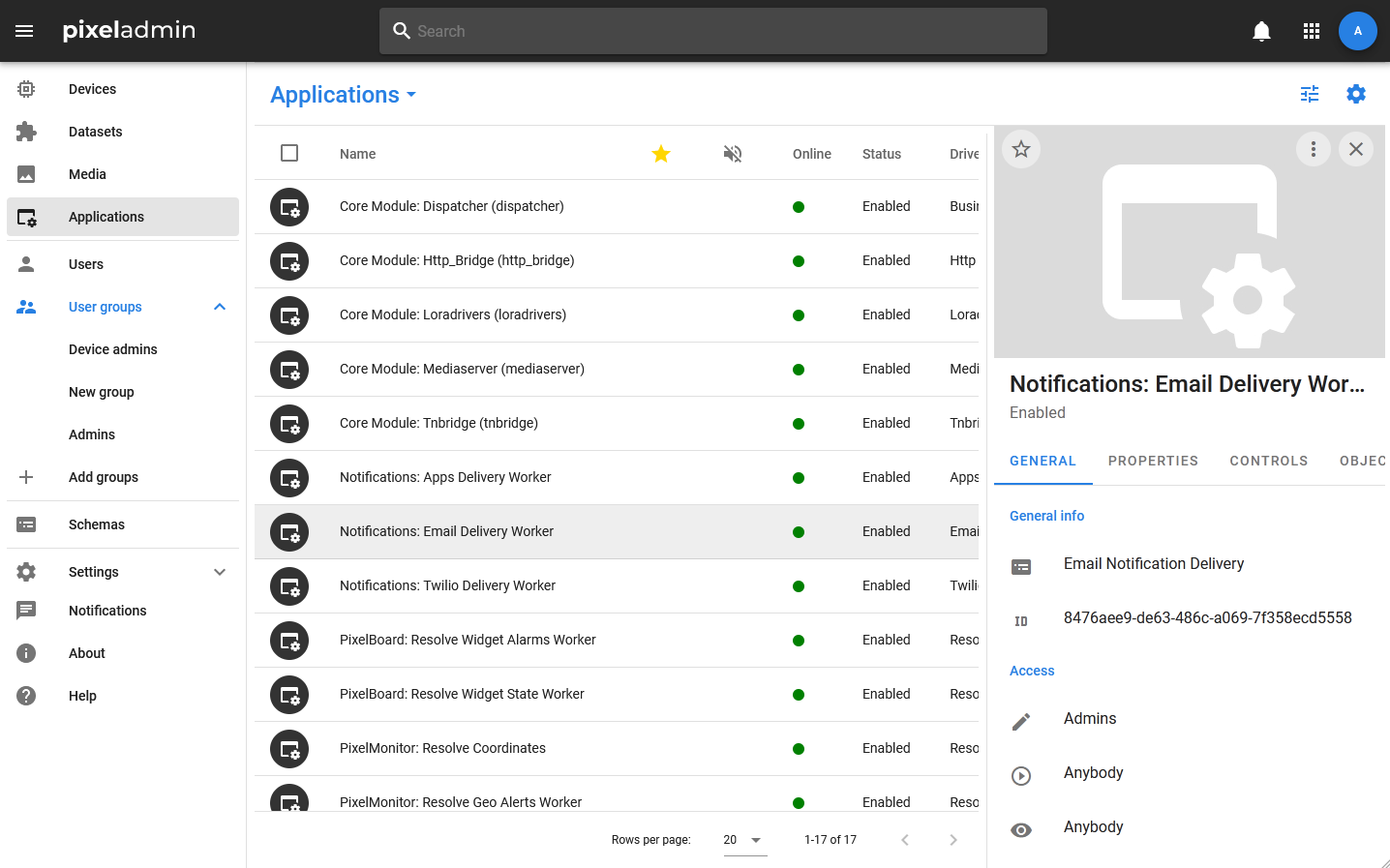
The application table opens when you select the item of the same name in the menu. It displays the following information:
- Name — icon and name of the application. The device icon is set by the data schema, and the name can be set and changed by the user. Within a party, the names of applications are not unique.
- Favorites — mark whether the device has been added to favorites.
- Online — shows the status of the application. If it is currently active, a green dot lights up in the table cell.
- Muted — mark whether notifications are disabled from the object.
- Status — the status of the application, takes the values Enable and Disable. The Disable status means that the appserver will ignore updates to the properties of this object coming from applications, and the object itself will not send any notifications.
- Driver name — name of the data schema that was used to create this object.
- Editors — the group that has the Edit right.
- Users — the group that has the right to Use.
- Readers — the group that has the Read right.
Detailed information about the application is displayed in the card that appears when you select a line. The card includes the following tabs:
- GENERAL — a tab with basic information about the application. It displays the name of the data schema on which the application was created, information about access rights, a description of the application and its UUID.
- PROPERTIES — a tab that displays all the properties of the application with their current values.
- CONTROLS — a tab that displays all the methods that can be used to work with the application. Each method has an icon indicating its status (installed, requested, running, error).
- OBJECTS — a tab with a list of objects associated with this application.
- NOTIFICATIONS — notifications related to this application.
Creating a application
It is assumed that application objects should be created automatically by the applications themselves when they get access to Pixel Core. However, there may be situations when the application cannot create such an object itself or does not have the appropriate permissions for this. To do this, you need to publish a data schema that meets the needs of the application (working with data schemas is described in the section of the same name), and then create a new object based on it.
To create a new application, open the application table and select Applications > Add new in its toolbar. After that, a window opens asking you to specify the name of the data schema to be used, the name of the application, and the Enable / Disable status value.
After the application is created, its card opens and you can set the values of individual properties.
Managing applications
The following actions are available in the context menu of the application card:
- Edit — edit basic information about the application. It includes the name, the Enable / Disable status value, and a description.
- Change access — edit access rights.
- Disable / Enable — change the status of Disable / Enable. If the application has the status Disabled, it will neither receive nor send any data.
- Mute — disable notifications from the application.
- Send notification — sends a notification associated with this application.
- Show history — view the history of the application. The history can be uploaded in CSV format.
- Show controls history — view the history of the controls. The history can be uploaded in CSV format.
- Edit healthcheck — checking the status of the application.
- Download notifications — download notifications. In the dialog box that opens, you can select the date range within which notification records should be included in the table. After that, you can download the table in CSV format.
- Copy UUID — copy the UUID of the application.
- Delete — delete.
Properties
Object properties can be changed in groups by calling the corresponding window via the menu, or individually.
The following actions are available for a single property:
- Edit property — changing the value of a property.
- Copy — copies the name and current value of the property to the clipboard.
- Set default — the value of the property changes to the default value stored in the data schema (if any).
- Link — setting up the link. Allows you to select a property of another object, the value of which will be automatically copied to the current property. If a link has been created for a property, the corresponding icon will be displayed next to it.
- Set null — makes the value empty.
- Show history — opens a window for viewing the history of changes to the property.
History
The history stores information about each new property value, the time of the value change and the author of these changes. You can view the history for all the properties of an object (to do this, select Show History in the object menu) and the history of an individual property (select Show history in the menu of the property itself).
The history is displayed in a special window. In its menu, you can select the period for which the history should be displayed (day, week, month). If you need to get a history for a certain period, you can save it in CSV format.
To do this, you need:
- Open the history window.
- Open the menu by clicking on the three dots in the window header.
- Select Download History.
- In the window that opens, specify the date range.
- Click Download and wait until the download file is generated.
Important
Fields such as object name, main status, and description are not properties, and their changes are not displayed in the history.
Controls
Controls are interfaces for RPC calls. The list of available controls is displayed in the corresponding tab (if there is no such tab in the card, then they are not provided for by the data schema to which the object belongs). The list displays the names of controls and icons corresponding to their execution statuses. If there is no icon, it means that this control has not been called for the object yet. If the icon is red, it means that an error occurred during the execution of the controls.
The following actions are available for each control:
- Execute — execute controls. If the controls are called without parameters, a confirmation window will appear. If it is possible (or necessary) to specify parameters for it, a window opens in which you can enter them and confirm execution.
- Show history — show the history of controls calls.
History
The history of controls can be viewed both for the entire object and for individual controls (by analogy with the history of properties). When you select the Show History menu item, a list opens in which the names of controls are displayed with icons corresponding to their execution statuses (success or error), as well as the time of the call and the initiator’s login.
Since the number of parameters for different controls varies and can be very large, their values are not displayed in the list itself. To see with what parameters the controls were called, you need to select the Info item in the menu of a specific call.
In this case, a window opens in which detailed information about the execution of controls is displayed. You can copy it by clicking on the button at the bottom of the window.
Linked objects
Linked objects are objects whose cards can be viewed from the current object. They are not dependent, but can be used for various specific settings (for example, this is used in a Pixel Monitor). An object can contain any number of linked objects and can itself be linked to any number of objects.
Media are also linked objects, but they are placed in a separate tab so that they are displayed not as a list, but as cards with images and information about files.
You can always link both an existing and a new object of any type to an object by using the buttons in the corresponding tabs of the card.
Fragments
Fragments are also objects. But if the linked objects remain independent and no restrictions are imposed on them, fragments, on the contrary, are subordinate. They cannot be removed or disconnected from the main object.
For fragments, actions such as viewing the history of properties and properties and copying the UUID are available.